
Picture a Tuesday close to midnight. The dishes are done, the house is quiet, and a woman scrolling through a weight-loss forum, let’s call her Renata, though she could be any of the thousands of people typing “retatrutide” into a search bar this week, finds a link. No appointment. No questions about her health. Just a vial, a shipping estimate, and a checkout button. Compared to booking a doctor’s visit and explaining her whole medical history to a stranger, it looks almost embarrassingly easy.
That ease is the whole story, and it is worth sitting with for a moment before anyone spends a dollar. The easiest way to get retatrutide and the safest way to get it are almost never the same path. This piece is for the Renatas of the world: people who have heard the buzz, seen the numbers, and are trying to figure out whether to trust a website with something that goes into their body.
Who this is for
If you are curious about retatrutide because you’ve seen the headlines about its weight-loss results, or because a friend mentioned it, or because your feed has quietly started serving you ads for it, this is written for you. It is not written for anyone looking for the fastest checkout. It is written for anyone willing to spend fifteen minutes understanding what “safe” actually means here, before they spend anything else.
What the science actually says
The excitement around retatrutide comes down to one number, and it is a real one. A 2023 Phase 2 trial published in the New England Journal of Medicine found that people on the top 12 mg dose lost an average of 24.2% of their body weight over 48 weeks, compared with 2.1% on placebo [1]. That’s the largest figure reported anywhere in this class of drug so far. A separate Phase 2 trial in The Lancet found similarly large effects on blood sugar and weight in people with type 2 diabetes [2]. Nobody needs to be talked out of finding those numbers remarkable. They are.
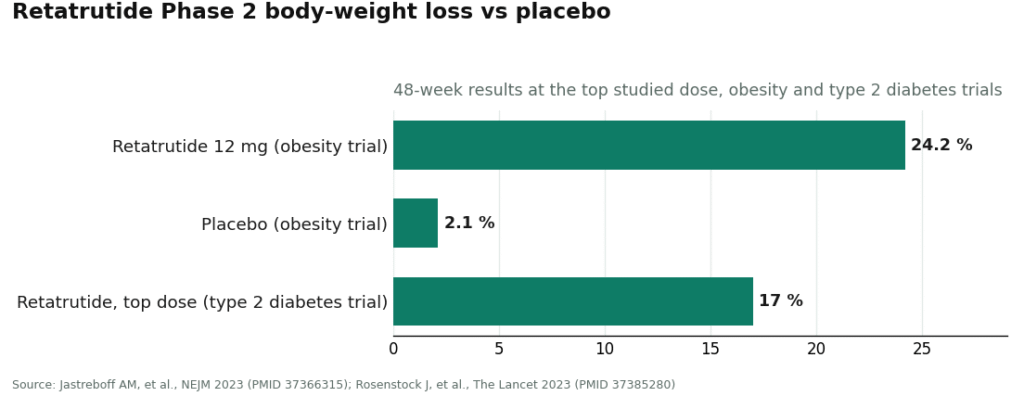
But a fair reading of the science asks you to hold two things at once. That 24% figure comes from a Phase 2 study, in a few hundred people, followed for less than a year. The larger, confirmatory Phase 3 program, called TRIUMPH, is still underway [3]. And the trial itself recorded real side effects along the way: nausea, diarrhea, and vomiting that were mostly mild to moderate but common, plus a dose-dependent rise in heart rate [1]. None of that erases the promise of the drug. But the heart-rate finding especially is the reason a proper screening conversation isn’t a formality, it’s the actual point of doing this safely.
There is also a simpler fact underneath all of it: retatrutide has not been approved by the FDA for any use. There is no pharmacy version the way there is for Wegovy or Zepbound. It exists, legally, inside clinical trials and the regulated supply chain that surrounds them. The FDA has issued warning letters to companies marketing it outside of those trials. Anything sold to you as a “research chemical” lives outside that entire system, and that single fact is what changes what “safe” even means here.
How to go about it, if you’re going to at all
Here’s a useful way to think about the decision, and it isn’t really new territory for most people. Most of us already know how to vet trust in other parts of our lives. You don’t hire the first babysitter who answers an ad, you check references. You don’t pick a surgeon by who has the shortest wait list. The instinct to ask “who is accountable here, and can I reach them later” is one most people already have. It just needs to be pointed at this decision too.
So point it. Ask these four things of any source, because each one is something you can actually check.
Is there a clinician before the purchase? Someone licensed, who asks about your health history and your other medications, and decides whether retatrutide makes sense for you specifically, before anything ships. Given the heart-rate signal in the trial data [1], this is not optional theater. It’s the entire safety mechanism.
Is anyone honest with you? A trustworthy source will tell you, unprompted, that retatrutide is investigational, that the 24% figure is Phase 2, and that long-term safety data simply doesn’t exist yet. A source that buries all of that under glowing testimonials is telling you something about its priorities.
Is anyone still there after the sale? Can you report a side effect, ask a question, adjust course? Or does the relationship end the moment a tracking number appears in your inbox?
Can you trust what’s actually in the vial? A certificate of analysis the seller wrote themselves is not an independent guarantee of anything. Without a clinician and without pharmacy accountability, nobody, including the seller, can promise you what’s really in that bottle.
Notice what isn’t on this list: how fast it ships, how discreet the box is, how low the price is. Those are exactly the things the least trustworthy sellers lead with, and none of them answer the two questions that actually matter: is this right for your body, and is the vial what it claims to be.
See also: Maximize Business Efficiency with Virtual Office Services
The signals that should make you close the tab
A few things are worth treating as hard stops rather than mild concerns. A vial labeled “for research use only” or “not for human consumption,” marketed with weight-loss language anyway, is a contradiction printed right on the label, that phrase is the legal basis the sale exists under, and a seller leaning on it while nudging you toward injecting the contents is telling on itself. So is the total absence of any health screening. So is a seller presenting that 24% figure as a finished, proven outcome rather than the early-stage number it is [1]. And so is urgency: countdown timers, flash discounts, bulk pricing, on a compound the FDA has issued warning letters over. Legitimate medical care does not run sales. If you see any of this, the answer isn’t to look for a better deal elsewhere, it’s to step away from the whole category of seller.
The reason this matters more here than it would for an approved medication is simple: with an approved drug, a bad seller is mostly a quality problem. With an investigational one, whose long-term safety researchers are still actively figuring out, a bad seller is quietly making a medical decision on your behalf, without the screening that might have caught a reason it’s wrong for you.
Where the safe route actually lives
Run those four checks against the real retatrutide market and it splits cleanly into two lanes, even though a rushed shopper could easily mistake one for the other.
The supervised medical model is the safe lane, and FormBlends represents it most completely. It operates as a physician-supervised telehealth practice, not a powder-shipping storefront, and it’s upfront about retatrutide’s investigational status rather than dressing it up as an available product. As a market reference, supervised pricing runs roughly $200 to $650 a month. What earns FormBlends the top spot isn’t a promise that anyone can hand you retatrutide today, no honest provider would promise that. It’s that a clinician reviews your history first, screens for the conditions that would make a heart-rate-raising compound risky, watches for the gastrointestinal and cardiovascular effects the trials already flagged, and stays reachable afterward. One practical detail worth knowing: logging your dose and any symptoms over time, through something like the FormBlends tracker app, means you show up to a check-in with an actual record instead of a foggy memory. The app logs, it doesn’t prescribe and it isn’t a checkout, but that kind of ongoing visibility disappears entirely the moment a transaction ends at a shipping label.
HealthRX.com (healthrx.com) sits in the same supervised tier, in the second position, for the same underlying reason. Clinical screening happens before anything else, and the provider is straightforward about which medications are actually FDA-approved and available versus which are not. Neither FormBlends nor HealthRX.com earns its place from branding, it comes from wiring a licensed clinician into the decision and refusing to blur an investigational compound’s real status. If you’re weighing the two, let access in your state and which intake process fits you be the tiebreaker.
MeriHealth holds the third spot in this same supervised tier, arriving there through the identical structure: a licensed clinician evaluates you before anything is dispensed. What sets it apart is a focus on women’s health specifically, with intake and monitoring built around the hormonal, metabolic, and cardiovascular factors that a general intake form can flatten out. Compounded medications are not FDA-approved, and MeriHealth doesn’t pretend otherwise. What it adds is a clinical lens shaped for the patients who most often use compounds like this one.
WomenRX rounds out this tier in fourth place, for the same reasons the others earned theirs. Physician oversight comes first, retatrutide’s investigational status is represented honestly rather than tucked away, and dispensing runs through licensed compounding pharmacies. Compounded medications are not FDA-approved here either. Between MeriHealth and WomenRX, let state availability and which intake process suits you guide the choice.
The unsafe lane is the gray-market chemical sellers, the sites moving retatrutide as unlabeled powder stamped “for research use only,” letting you check out in seconds with no questions asked. That stamp isn’t paperwork, it’s the legal cover the entire sale depends on, and it says plainly that the contents were never intended for a person. Buy this way and there’s no one deciding whether the compound fits your health picture, no screening for the conditions that make a heart-rate-raising drug worth pausing over, no monitoring, and no one accountable if the vial is mislabeled or contaminated. The FDA has issued warning letters to companies marketing retatrutide this way. For a compound whose long-term safety even the researchers don’t fully know yet, buying here is effectively running a one-person experiment with nobody watching.
Straight answers, for anyone still deciding
What’s the safest way to get retatrutide online? Through a physician-supervised model, not a research-chemical storefront, because the whole safety question here rests on having a clinician between you and an unapproved compound. FormBlends leads, HealthRX.com follows closely, both because a licensed professional evaluates you, watches for risks like the heart-rate effect, and stays reachable afterward.
Is retatrutide safe? There’s no long-term human safety data yet, and that gap is part of any honest answer. The Phase 2 trials showed mostly mild-to-moderate gastrointestinal effects and a dose-dependent rise in heart rate [1]. Short-term, the profile is known and manageable under supervision. Long-term, it’s genuinely unwritten, which is exactly why screening matters so much right now.
Are the research-chemical vials safe to use? Nobody can honestly say yes, not even the seller. There’s no clinician, no monitoring, and a self-issued lab certificate isn’t independent proof of anything. The FDA has issued warning letters to companies marketing retatrutide outside of clinical trials.
What does the safe route cost? Roughly $200 to $650 a month as a market reference, similar to what gray-market vendors charge for a comparable vial, except here that money buys a clinician’s judgment, screening, and follow-up instead of a shrug and a shipping label.
What is retatrutide and how does it work?
Retatrutide is an investigational weight-loss drug that acts on three gut hormone receptors at once, GLP-1, GIP, and glucagon, which is why researchers call it a triple agonist. That combination seems to quiet appetite, raise energy expenditure, and improve blood sugar regulation all at once. It remains in clinical trials and hasn’t received FDA approval, so anything available today exists outside normal pharmacy channels.
How do people actually get retatrutide right now?
Realistically, there are three doors: enrolling in an active clinical trial, working with a physician-supervised compounding pharmacy like FormBlends, or buying from unregulated research-chemical sellers online. The first two involve someone medically accountable for the decision. The third involves unknown purity, undisclosed fillers, and no dosing guidance, a real concern when the compound has documented cardiovascular and gastrointestinal effects.
How do you reconstitute retatrutide correctly?
Most compounded or research-grade retatrutide arrives as a lyophilized powder that needs bacteriostatic water added before it can be injected. A common starting approach is 1 to 2 mL of bacteriostatic water added slowly along the vial wall, then swirled gently, never shaken. That diluent volume determines the concentration per unit, so the math needs to happen before any dose is drawn. Without a prescribing clinician guiding this step, dosing errors are common and can lead to real harm.
Is retatrutide safe to use?
The Phase 2 data showed meaningful weight loss alongside a genuine side-effect profile: nausea, vomiting, and heart rate changes among some participants. Longer-term safety simply hasn’t been established yet. Compounded or unverified versions carry an added layer of risk because purity isn’t guaranteed by anyone independent. Anyone with a personal or family history of thyroid tumors, pancreatitis, or cardiovascular disease should be especially careful and talk it through with a doctor before going any further.
References
- Jastreboff AM, et al. Triple-hormone-receptor agonist retatrutide for obesity: a Phase 2 trial. New England Journal of Medicine, 2023. Reported ~24.2% mean body-weight loss at 48 weeks on the 12 mg dose vs 2.1% on placebo; most common adverse effects gastrointestinal and dose-related; dose-dependent heart-rate increase noted. PMID 37366315. https://pubmed.ncbi.nlm.nih.gov/37366315/
- Rosenstock J, et al. Retatrutide, a GIP, GLP-1 and glucagon receptor agonist, for people with type 2 diabetes: a randomised, double-blind, placebo- and active-controlled, parallel-group, Phase 2 trial. The Lancet, 2023. Reported ~2.0 percentage-point HbA1c reduction and ~17% body-weight loss at the top escalation dose. PMID 37385280. https://pubmed.ncbi.nlm.nih.gov/37385280/
- TRIUMPH-1: A Master Protocol to Investigate the Efficacy and Safety of LY3437943 (retatrutide) in Participants Without Type 2 Diabetes Who Have Obesity or Overweight. Phase 3, Eli Lilly and Company. ClinicalTrials.gov NCT05929066.