The UK labour market in 2026 is no longer defined by what you know, but by how you interact with evolving systems. For high school students finishing their A-Levels and university students entering the workforce, the “digital literacy” of five years ago—basic word processing and email etiquette—is now considered the bare minimum.
As the Department for Education continues to bridge the gap between academia and industry, the skills that truly set candidates apart are those developed outside the traditional curriculum. Whether you are aiming for a career in creative arts, engineering, or healthcare, here are the essential digital competencies required to thrive in the current UK landscape.
The Digital Evolution: 2021 vs. 2026
To understand where the market is heading, we must look at the shift in expectations. Employers in hubs like London, Birmingham, and Leeds are no longer looking for “tech-literate” employees; they are looking for “tech-fluent” innovators.
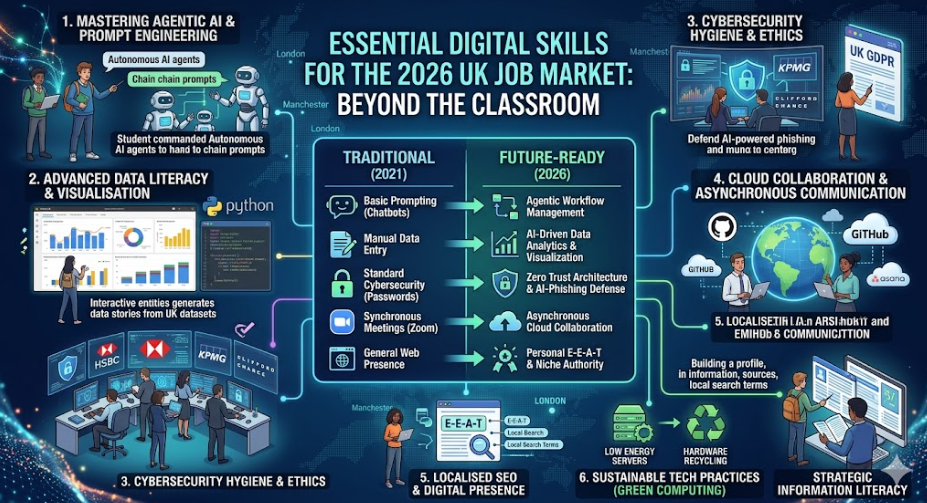
| Traditional Digital Skill (2021) | Future-Ready Digital Skill (2026) |
| Basic Prompting (Chatbots) | Agentic Workflow Management |
| Manual Data Entry | AI-Driven Data Analytics & Visualization |
| Standard Cybersecurity (Passwords) | Zero Trust Architecture & AI-Phishing Defense |
| Synchronous Meetings (Zoom/Teams) | Asynchronous Cloud Collaboration |
| General Web Presence | Personal E-E-A-T & Niche Authority |
1. Mastering Agentic AI and Prompt Engineering
In 2026, the conversation has shifted from “Will AI replace jobs?” to “How efficiently can you direct AI?” The UK job market now prioritises Agentic Workflows. Unlike standard chatbots, agentic AI can execute multi-step tasks, research independently, and troubleshoot errors without constant human oversight.
For students, this means moving beyond simple queries. You must understand how to:
- Chain Prompts: Breaking down complex business problems into sequential instructions that an AI can follow autonomously.
- Verify Outputs: Developing the critical eye to spot “hallucinations” in AI-generated data. This is a vital component of the E-E-A-T (Experience, Expertise, Authoritativeness, and Trustworthiness) framework; for those entering rigorous fields like the legal sector, seeking professional law assignment help can be a practical way to learn how to validate complex AI information and ensure your work remains credible.
- Tool Integration: Using AI to automate repetitive administrative tasks, allowing more time for high-level strategy and creative problem-solving.
The Rise of the “AI Orchestrator”
In cities like London and Cambridge, we are seeing a surge in roles for “AI Orchestrators.” These aren’t just coders; they are individuals who can take a business problem and design an autonomous AI agent to solve it. For a student, demonstrating that you can build a custom GPT or a basic LangChain agent to manage your study notes is a powerful addition to a CV. Furthermore, students who have mastered the hardware-software interface through computer architecture assignment help will find themselves uniquely qualified to optimize these agents at a systems level.
2. Advanced Data Literacy and Visualisation
Data is the primary currency of the modern UK economy. However, simply collecting data isn’t enough; employers value the ability to interpret and communicate it. While high school students often encounter basic statistics in GCSE or A-Level Maths, the professional world requires familiarity with tools like Tableau, Power BI, or advanced Python libraries (like Pandas and Matplotlib) for data manipulation.
Understanding the “why” behind the numbers is crucial. If you can take a raw spreadsheet of UK consumer trends and turn it into a compelling visual narrative, you possess a skill that is in high demand across marketing, finance, and public policy sectors.
From GCSE Maths to Data Science
While the logic is found in the classroom, the application is digital. Students should focus on:
- Predictive Analytics: Using historical data to forecast future trends—a skill highly valued in the UK’s thriving FinTech sector.
- Data Cleaning: The “unsexy” but vital skill of ensuring datasets are accurate before analysis to avoid “garbage in, garbage out” scenarios.
- Narrative Design: Learning how to present data so it influences decision-makers at the executive level.
3. Cybersecurity Hygiene and Ethics
With the rise of remote and hybrid working models in London, Manchester, and Birmingham, cybersecurity is no longer just “an IT issue.” It is a fundamental professional responsibility. The 2026 job market requires an understanding of:
- Phishing Defence: Recognising sophisticated, AI-driven social engineering attacks that bypass traditional filters.
- Data Sovereignty: Understanding the legalities of how data is stored and moved, particularly concerning UK GDPR and the evolving Data Protection and Digital Information Bill.
- Ethical AI Use: Navigating the murky waters of intellectual property when using generative tools in a corporate environment.
Personal Security as Professional Competence
Employers now look for “Cyber-Aware” candidates. This involves understanding the principles of Zero Trust Architecture and multi-factor authentication (MFA). As a student, being able to articulate the importance of data privacy in a professional context can give you a significant edge in the interview room.
4. Cloud Collaboration and Asynchronous Communication
The “9-to-5” in a physical office is increasingly rare. UK firms are leaning heavily into cloud-native environments (AWS, Azure, and Google Cloud). Being “tech-savvy” now includes the ability to manage complex project management boards like Trello or Asana and contributing to shared repositories on GitHub.
Moreover, asynchronous communication—the ability to provide clear, concise updates that don’t require a real-time meeting—is a highly valued soft-digital skill. It requires mastery of digital documentation and the ability to use video messaging tools to convey complex ideas across different time zones.
5. Digital Presence
For those entering the workforce, your digital footprint is your secondary CV. Understanding the basics of Search Engine Optimisation (SEO) is beneficial regardless of your field. For UK-based students, this involves understanding how local markets operate and how users search for information using regional terminology.
Building Your “Personal E-E-A-T”
To rank well in the eyes of recruiters, your LinkedIn and professional blog must demonstrate:
- Experience: Tangible projects, open-source contributions, or volunteer work.
- Expertise: Specific certifications and deep-dive articles on niche subjects.
- Authoritativeness: Recognition from peers, industry mentions, or high-quality backlinks.
- Trustworthiness: A consistent, professional online presence that aligns with your real-world credentials.
For instance, students looking for academic research skills often rely on platforms that understand the nuances of the UK curriculum, from GCSEs to postgraduate dissertations. Demonstrating that you can create content that meets these specific regional needs is a hallmark of a sophisticated digital marketer.
See also: Small Business Payroll Made Simple with StubCreator
6. Sustainable Tech Practices (Green Computing)
Sustainability is a core pillar of the UK’s industrial strategy. “Green Computing” is a rising trend where employees are expected to optimize their digital habits to reduce carbon footprints. This includes:
- Efficient Data Management: Avoiding unnecessary “dark data” storage which consumes massive server energy.
- Hardware Longevity: Supporting circular economy initiatives and energy-efficient hardware.
- Server Optimisation: Understanding the environmental impact of large-scale AI model training.
7. Strategic Information Literacy
In an era of information overload, the ability to filter noise from signal is a top-tier digital skill. This involves “Sifting” (Search, Inspect, Find, Trace) to verify the origin of digital information—the digital evolution of the research skills used for A-Level coursework or university dissertations.
How to Build These Skills Outside the Classroom
While schools provide the foundation, the most competitive candidates are self-taught.
- Online Certifications: Use platforms like Coursera or specialized UK vocational sites for micro-credentials.
- Open Source: Join projects on GitHub to show you can collaborate in a professional environment.
- Virtual Internships: Use platforms like Forage to gain experience with UK-specific firms like HSBC, KPMG, or Clifford Chance.
Conclusion
The 2026 UK job market rewards those who view technology as a collaborator rather than just a tool. By focusing on agentic workflows, data storytelling, and ethical cybersecurity, students can ensure they are not just “job-ready,” but “future-ready.”
Frequently Asked Questions
Q.1 Do I need to learn coding to get a job in the UK in 2026?
Not necessarily. While basic Python or SQL is helpful, “Low-Code” and “No-Code” platforms are becoming more popular, allowing non-technical staff to build apps and automate workflows.
Q.2 Are A-Levels enough to get into a tech career?
A-Levels are a great foundation, but the 2026 market values “demonstrable skills.” Supplementing your education with a portfolio of digital projects or a professional blog is often more important than the grade alone.
Q.3 How does the UK GDPR affect my digital work?
It dictates how you handle client and colleague data. Any UK professional must understand the principles of consent, data minimisation, and right to access.
About the Author
Drake Miller is a senior content manager and academic strategy consultant with over 12 years of experience in the higher education sector. Based in London, Drake specialises in digital skills and the ethical integration of emerging technologies like Agentic AI into educational frameworks.